


Hundreds of Tao Aborigines living on Lanyu (蘭嶼), also known as Orchid Island, yesterday held a protest outside the Lanyu nuclear waste storage facility, calling on Taiwan Power Co (Taipower, 台電) to remove nuclear waste from the island as soon as possible.
Clenching their fists as they stared straight ahead with angry faces and shouted in low-pitched voices, the Tao, in traditional dress, performed a ritual to drive away evil spirits near Longmen Harbor, the debarking point for nuclear waste from Taiwan proper and where yesterday’s march against the storage of nuclear waste on the island began.
Despite stormy weather, about 500 people from the island’s six villages marched along Lanyu’s west and east coasts, before the two groups joined together for a rally in front of the storage facility.
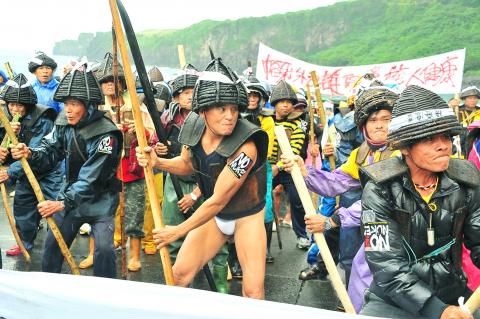
Photo: Chang Tsun-wei, Taipei Times
“We love Lanyu! Nuclear waste, out!” the marchers shouted.
“It’s been 30 years [since nuclear waste was first stored on Lanyu] and we’ve had enough,” Lanyu Township Councilor Sinan Kamatahen told the crowd.
“Because of the nuclear waste, the health of we Tao people has been deteriorating. We’re worried that, soon, the already disadvantaged Tao people are going to disappear from the face of the Earth,” she said.
“If President Ma Ying-jeou (馬英九) really cares about Aborigines, he should be more serious about listening to what we have to say, and so should Taipower,” she said. “It’s a matter of life and death for us.”
Since 1982, when the storage facility was completed, about 98,700 barrels of nuclear waste from the nation’s three operational nuclear power plants have been stored at the Lanyu complex.
While Lanyu residents have long protested against the facility, they have become more concerned following the crisis at Japan’s Fukushima Dai-ichi nuclear power plant last year.
A report released in November last year that said a radioactive leak had been detected outside the facility also added to residents’ concerns.
“Taipower has always told us that it’s completely safe, but how do they explain the high cancer rate since the facility was built?” Sinan Kamatahen asked. “There’s been too much deception, we want the truth.”
Medical records show that in the three decades since the facility began operating, the number of cancer patients has been rising. However, there has been no official investigation into the impact of the facility on residents’ health.
Chang Hai-yu, a preacher at a local church, said it was a tragedy that Tao children are being born into a radiation-filled environment.
Lanyu Township Mayor Chiang To-li (江多利) urged Taipower to remove nuclear waste from the island as soon as possible.
“We protested here 10 years ago and we’re back again today because what Taipower promised us has not yet been fulfilled,” Chiang said. “We’re here again, pleading for the health and life of all Lanyu residents.”
Chiang was referring to a Taipower promise to remove all nuclear waste by 2016.
In response to the protest, Lee Ching-shan (李清山), director of Taipower’s nuclear back-end management department, said the company was sincere about its promise, but that it was a complicated process.
“Ten years ago, we promised to remove the nuclear waste and to check all the nuclear waste barrels,” Lee said. “We completed the barrel check in November and we’re actively searching for a new storage site.”
At the time of the pledge, Taipower said it would find a new site for a nuclear waste storage facility within five years after a set of regulations regarding site selection was adopted by the legislature. It also said it would finish building the facility within five years and the moving process within another four years.
“So far, we’ve had some candidate sites, but referendums by locals are yet to be held to make the final decision,” Lee said. “We’re working hard to fulfill our promise, but I have to say that, because of various delays, we may not be able to make it by 2016.”

The National Chungshan Institute of Science and Technology yesterday showcased its locally developed variants of the Vision 60 robotic patrol dog, which it plans to deploy on the nation’s outlying territories in the South China Sea. The variants were produced under the Joint Lab project — created by the institute and domestic companies — and assembled with domestically produced motors, lenses and artificial intelligence (AI) systems alongside licensed tech from the US, Missile and Rocket Systems Research Division deputy director Jen Kuo-kang (任國光) told the media event at a military base in Taipei’s Dazhi (大直) area. Taiwan has built up its strengths

RIGHT DIRECTION: Taiwan’s efforts to prevent forced labor include a proposal to ‘fully prohibit’ employers from withholding workers’ documents, an official said Taiwan is to establish a mechanism to restrict imports of goods linked to forced labor, the Executive Yuan said yesterday, after the US proposed imposing additional tariffs on Taiwanese goods over labor concerns. “The Ministry of Labor and the Ministry of Economic Affairs are to establish an interministerial review procedure,” Executive Yuan spokesperson Michelle Lee (李慧芝) said at a news briefing in Taipei. “The government is to use the Foreign Trade Act [貿易法] as the legal basis to restrict imports of goods produced with forced labor” and bring its supply chain governance more in line with international standards on human rights, resilience

NOT IMMEDIATE: Taiwan has a chance to appeal the proposed 10 percent tariff before it starts, while other countries face a 12.5 percent tariff from the trade office Taiwan is among 60 economies determined by the US to have failed to impose or enforce a ban on the importation of goods produced with forced labor, according to a notice released on Tuesday by the Office of the US Trade Representative (USTR), which proposed imposing an additional 10 percent or more tariff on them. The USTR in a statement said that following an investigation, it had determined under Section 301 of the Trade Act of 1974 that the failure of the 60 economies to impose and effectively enforce a prohibition on the importation of goods produced with forced labor is

TIT-FOR-TAT: The US allegedly revoked the visa of a Chinese national working at Xinhua News Agency in the US in response to Beijing’s expulsion of Vivian Wang The Presidential Office yesterday condemned China for expelling a New York Times correspondent from Beijing following the newspaper’s interview with President William Lai (賴清德), saying the move highlighted Beijing’s suppression of press freedom and its threat to international news media. Taiwan has noted a series of recent incidents in which Beijing used similar tactics to “threaten and pressure international media outlets and journalists,” Presidential Office spokeswoman Karen Kuo (郭雅慧) said in a statement. “This concerns not only press freedom and freedom of expression, but also the safety of journalists, and Taiwan and relevant partners are paying close attention to the situation,” she


 RSS
RSS